At World AI Forum, Four Signs China’s AI Industry Is Growing Up
This year’s World Artificial Intelligence Conference in Shanghai was larger, more crowded, and more politically prominent than in previous editions.
President Xi Jinping attended the event for the first time, while more than 1,100 companies showcased computing systems, AI agents, robots, and other products aimed at workplaces, factories, and consumers. In-person visits topped 400,000, and tickets were reportedly resold for more than 1,000 yuan.
Xi called for wider access to open-source AI, and China launched a 29-country AI cooperation body, placing issues of governance, access, and international coordination alongside the usual displays of commercial technology.
Beyond the speeches and packed exhibition halls, the most revealing conversations were practical: lowering computing costs, putting AI agents to work, managing new safety risks, and building businesses that can last.
Here are four takeaways from this year’s WAIC.
Computing power gets practical
Computing power was one of the most discussed topics at this year’s WAIC, second only to AI applications by number of related forums. But the focus moved beyond building more data centers or training ever-larger models.
Two questions dominated: what the next generation of computing power might look like, and how to make today’s resources cheaper and more efficient.
At one flagship forum on the future of computing, scientists discussed emerging approaches including quantum computing and space-based computing. Among the speakers was Pan Jianwei, a leading quantum physicist and recent recipient of a top United Nations science award, who outlined recent advances in the field.
Pan also urged caution. Although the field has reached a series of important milestones, he said, building a general-purpose quantum computer capable of quickly solving problems with clear practical value will still require years of sustained research. The academic community, he added, has a responsibility to help the public assess the technology realistically and guard against an industry bubble.
Companies also seemed more focused on improving the efficiency of existing computing resources and reducing the cost of each AI query.
Some were working to improve the performance of models trained mainly on Nvidia chips when deployed on Chinese chips. Others focused on allocating and managing computing resources more efficiently.
Rather than chasing only the most powerful and expensive models, many Chinese AI companies appeared more concerned with making AI cheaper to run.
AI Governance and Safety
AI governance and safety were prominent throughout this year’s WAIC, from high-level forums to the opening ceremony and President Xi Jinping’s speech.
Brian Tse, an AI safety expert and founder and CEO of Concordia AI, said he has seen more discussion in China around cybersecurity and the protection of critical infrastructure, especially the risks posed by frontier AI models.
“The threat landscape is evolving rapidly,” Tse said. “Many experts at the forums expressed concern that threats and potential misuse are developing faster than society’s current defenses.”
The concerns also appeared to be shifting beyond large language models and the harmful content they can generate. More attention was paid this year to the risks posed by autonomous AI agents, which can plan tasks, make decisions, and interact with other tools.
On July 15, just before WAIC, China’s new rules on AI anthropomorphic interaction took effect, targeting services that simulate human personalities and sustained emotional interaction. The rules prohibit providers from offering virtual partners or relatives to minors and bar services from inducing emotional dependence or addiction.
In May, regulators also released guidance on the standardized application and development of AI agents, including plans to explore digital identity management for them.
“China is positioning itself as an architect of multilateral AI governance,” Tse said.
AI lands at work
One phrase heard often at this year’s WAIC was AI’s real-world “landing” — the push to move the technology out of demos and into everyday work. Companies ranging from Tencent and Alibaba to smaller startups showed AI products aimed at offices, factories, and consumer services. AI agents were among the most visible examples.
At booths run by major tech firms, exhibitors demonstrated how agents could be built into corporate workflows, from searching internal documents to generating reports and coordinating routine tasks.
The impact could be broad because many of these companies’ software systems are already embedded in Chinese workplaces. Adding AI agents to existing platforms may prove easier than persuading companies to adopt entirely new tools.
Still, genuinely effective applications appeared limited. Office productivity remained the most obvious use case, while other areas were less developed.
Robotics and embodied AI occupied an entire floor at this year’s WAIC. Visitors could still see robots performing awkward dances or taking six minutes to make a cup of tea. But some companies were beginning to move beyond staged demonstrations, showing robots designed for inspection, manufacturing, logistics, and other industrial uses.
The founder rush
Some of the most revealing conversations at this year’s WAIC took place after the official sessions ended.
Across after-hours gatherings, private meetups, and open-mic sessions, young founders and industry professionals swapped ideas on AI agents, robotics, and productivity tools. Some gatherings ran late into the night, with almost any topic open for discussion.
Many entrepreneurs seemed eager to absorb every new idea, experiment, business opportunity, and professional connection they could find.
But that urgency also carried risks. Some founders said their AI ventures were burning through years of savings. Many still lacked a convincing answer to a basic question: how their projects would generate lasting value and revenue.
That tension ran through WAIC: crowded halls, founders eager to share projects and failures, and a palpable fear of moving too slowly and missing the AI wave. The mood mixed optimism with anxiety, much of it fueled by the speed of the technology and the sheer volume of information surrounding it.
The conversations also suggested a maturing industry. More speakers and founders were asking not only what AI could do, but where it could be useful, how it could be governed, and which businesses could survive once the initial excitement fades.
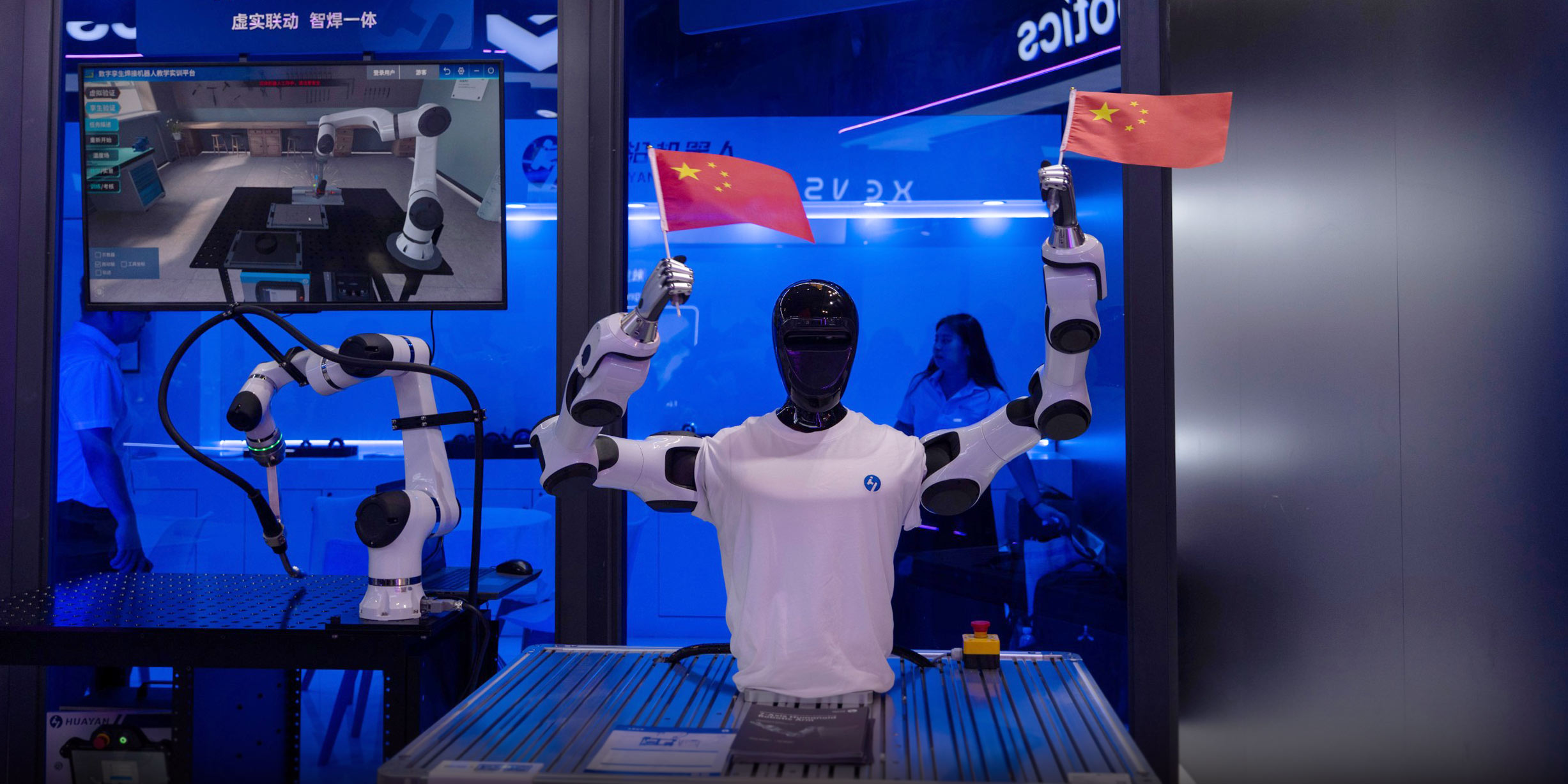
(Header image: A humanoid robot from a Chinese robotics firm waves Chinese national flags during the 2026 WAIC in Shanghai, July 18, 2026. Ng Han Guan/AP Photo via VCG)